I am excited to share that we have invested in Scout AI’s oversubscribed $100M Series A. The round was co-led by Draper Associates and Align Ventures, with participation from Decisive Point, Booz Allen Ventures, and many others.
We first invested in Scout AI at Seed and are proud to continue supporting the company as it builds the AI software layer for autonomous warfare.
Founded in 2024, Scout AI is developing the intelligence infrastructure that enables unmanned military systems to operate more effectively across ground vehicles, aerial systems, and command-and-control environments. The company is positioning itself as a pioneer in AI for defense, building the software that allows autonomous assets to interpret natural language commands, coordinate across platforms, and operate under real-world battlefield conditions.
Scout AI is tackling one of the most important gaps in modern defense technology: the lack of AI-native software across operational military systems. The U.S. military has invested heavily in hardware, from tanks and aircraft to ships and drones, but most systems still rely on limited software and require significant human involvement. This creates operational inefficiency and exposes military personnel to unnecessary risk.
The rules of modern warfare are changing quickly. AI-enabled intelligence, surveillance, reconnaissance, and the deployment of autonomous military assets are becoming increasingly decisive on the battlefield. Yet much of the defense technology ecosystem remains fragmented, with many emerging defense primes still focused primarily on hardware. This creates a large and urgent gap for an AI-native software layer that can coordinate autonomous systems across vendors, domains, and missions.
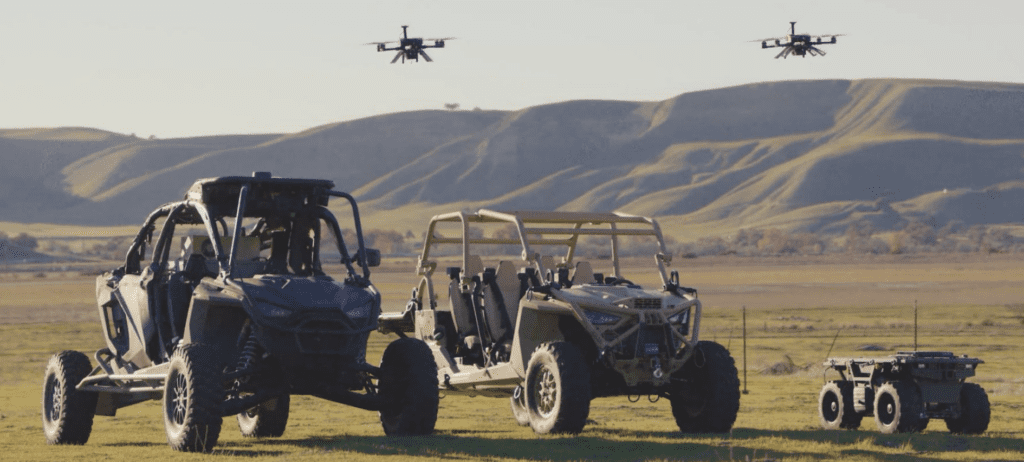
This is where Scout AI comes in. The company is building exactly that missing layer. Its foundation model, Fury, is already able to control ground vehicles and drones for the U.S. Army in daily operations. Scout AI also recently launched Fury Orchestrator, an AI system that enables a single commander to manage fleets of vendor-agnostic unmanned assets using plain language.
Instead of relying on manual control, fixed workflows, or vendor-specific software, Scout AI translates high-level commander intent into real-time tasks for each asset. The system can dynamically reallocate and adapt those tasks as battlefield conditions change, allowing autonomous systems to operate with greater coordination, flexibility, and effectiveness.
The momentum is already building. Fury is controlling ground vehicles and one-way attack drones in the U.S. Army’s daily operations. Scout AI has launched Fury Orchestrator, with the launch covered by Wired, and has secured $11M in DoD contracts across four active programs. The company has also recently inaugurated new headquarters, R&D, and manufacturing facilities to support its next phase of growth.
The opportunity is significant for Scout AI as defense systems shift from human-operated, hardware-centric platforms toward AI-native, software-defined autonomy.
We are proud to continue supporting Colby Adcock, Collin Otis, and the entire Scout AI team as they build what could become one of the defining AI platforms in defense.